


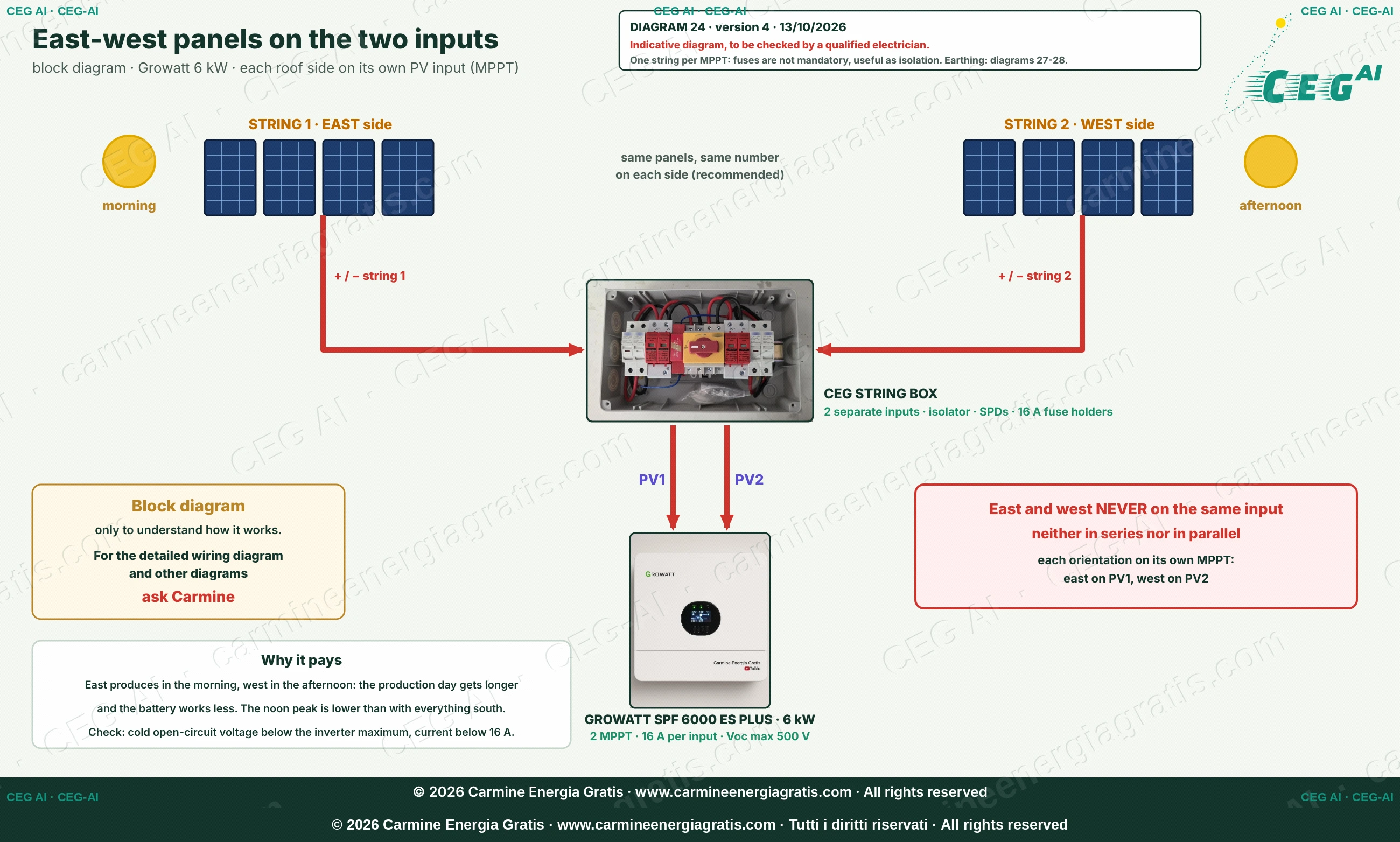
1. The principle
East panels get the sun in the morning, west panels in the afternoon. At the same moment they produce different currents and voltages. The inverter's tracker (MPPT) looks for the best operating point of the panels connected to it: if you mix east and west on the same input, it has to compromise and energy is lost.
So the rule is: east and west never on the same input, neither in series nor in parallel. East on PV1, west on PV2.
2. What you need
- Inverter with two MPPTs: the Growatt SPF 6000 ES PLUS has two, 16 A per input. Growatt inverters
- Two strings: same panels and same number on each side recommended.
- CEG string box with two separate inputs, isolator, surge protectors and 16 A fuse holders. DC box
3. Why it pays
The production day gets longer: east starts early, west finishes late. The midday peak is lower than with all panels facing south, so the battery works less and energy arrives more evenly during the day, when the house uses it.
4. The check to make
Before connecting, check two things for each string: the cold open-circuit voltage must stay below the inverter maximum, and the current below the 16 A of the input. Panel voltage rises in the cold. String calculator
With one string per input, string fuses are not mandatory, but the CEG box has them anyway and they are also useful for isolation.
5. Mistakes to avoid
- Putting east and west in series or in parallel on the same input.
- Calculating string voltage in summer instead of in the cold.
- Two roof sides with very different panel counts without checking.
- Forgetting earthing and surge protection (see the lightning diagram).
6. The detailed wiring diagram
The block diagram helps you understand how it works. The detailed wiring diagram, with terminals and connections, is reserved for those who bought through Carmine Energia Gratis: write to Carmine with your CEG pre-order number. Wiring and testing must be done by a qualified electrician.
7. Frequently asked questions
Can I put east and west in parallel on the same MPPT?
Not in the CEG diagram: each orientation goes on its own tracker. Together, the inverter has to compromise between two sides that behave differently.
Do I need the same number of panels on each side?
It is recommended, but with two separate inputs each string is tracked on its own. What matters is that each string respects the voltage and current limits of its input.
Does it produce less than an all-south system?
At peak, yes, but production is spread over more hours of the day. With a battery this is often an advantage.
Are string fuses needed?
With one string per input they are not mandatory. The CEG string box has them anyway, 16 A, and they also work as isolation.
Talk to Carmine
Before choosing components and connections, let us check your system together.