


For friends of the channel
DIY solar: free off-grid solar simulator
Size your DIY solar system: location, consumption and roof, and the simulator shows panels, battery, inverter and the hardest months to cover, one step at a time. Watch the demo video (in Italian).
Free · No registration · Keep your report for yourself
I only need one calculation →Your off-grid scenario
Read this scenario’s full report
PDF uses Print → Save as PDF. To combine this with other tools, press “Add to my report” below. Nothing is sent automatically.
How this estimate works
The starting panel count compares daily use with the least productive average month in your chosen period. It is only a starting point: PVGIS SHScalc then checks panels, battery and demand using historical hourly data. The table shows days when the battery reaches its reserve and average unmet energy.
PVcalc estimates potential production with 14% losses, crystalline silicon and ventilated modules. SHScalc uses its off-grid performance ratio of 0.67 including losses; 14% or 95% is not applied again. These outputs describe different quantities. Daily demand is constant, including occasional use; May–September reports only those months of the full-year simulation. Nearby shade, snow, power limits, ageing and specific backup strategies are not simulated.
PVGIS methods and limitations — European Commission / JRC
Shade and obstacles. For every obstacle you draw (chimney, aerial, skylight, dormer, satellite dish, nearby trees and buildings) the tool works out the sun’s position on the 21st of each month, from sunrise to sunset, every 15 minutes, and follows the shadow on the roof face. A panel touched by shade even partly is counted as switched off at that moment, because its bypass diode cuts it out. For each panel it gives the loss over the year and in the worst month and advises whether to leave it (shade only early in the morning or late in the afternoon, when the sun is low), fit an optimiser or move it. The PVGIS output stays complete; the kWh lost to shade are listed month by month in the project. Carmine suggests optimisers only on the panels shaded during the good hours: when the shade passes a certain share the panel is cut out and a string of 6 works like a string of 5, while the others keep producing.
Strings and inverters. With the Voc and Isc of the panel you choose, the tool works out how many panels to put in series: Voc × 1.12 for cold weather, preferring one panel fewer to one more. The limits come from the Growatt inverter datasheets: 6 kW with 490 V cold, 16 A and 4,000 W per input; 12 kW with 540 V, 27 A and 7,500 W per input; start-up at 120 V. Two roof faces are never mixed on the same string. For single phase it proposes 6 kW, 12 kW or 2 or 3 inverters of 6 kW in parallel; for three phase 3 × 6 kW (18 kW) or 3 × 12 kW (36 kW).
Battery. It works out the capacity needed for the days without sun you choose and compares it with CEG batteries: 16 and 17 kWh counted at 80%, the 34 kWh in full, with the autonomy of each and the estimated charging current.
Before buying, discuss it with Carmine
Bring your scenario: together we can assess the requirements, missing details and compatible components. First contact is by email. Phone and WhatsApp are available after a preorder or a consultation contribution of at least €20.
info@carmineenergiagratis.comHow useful did you find the CEG website?
One rating for the whole website. No name or email required.
How ratings are counted
One editable vote per browser, shared across the home page and all calculators. The average includes votes submitted or updated in the last 12 months. A functional cookie remembers your vote for up to 12 months. Clearing site data or using another browser can allow another vote. Ratings reflect voluntary submissions; visitors’ identities are not verified. Privacy details.
Solar panels in series and in parallel
In series, the voltages add up and the current stays the same. In parallel, the currents add up and the voltage stays the same.
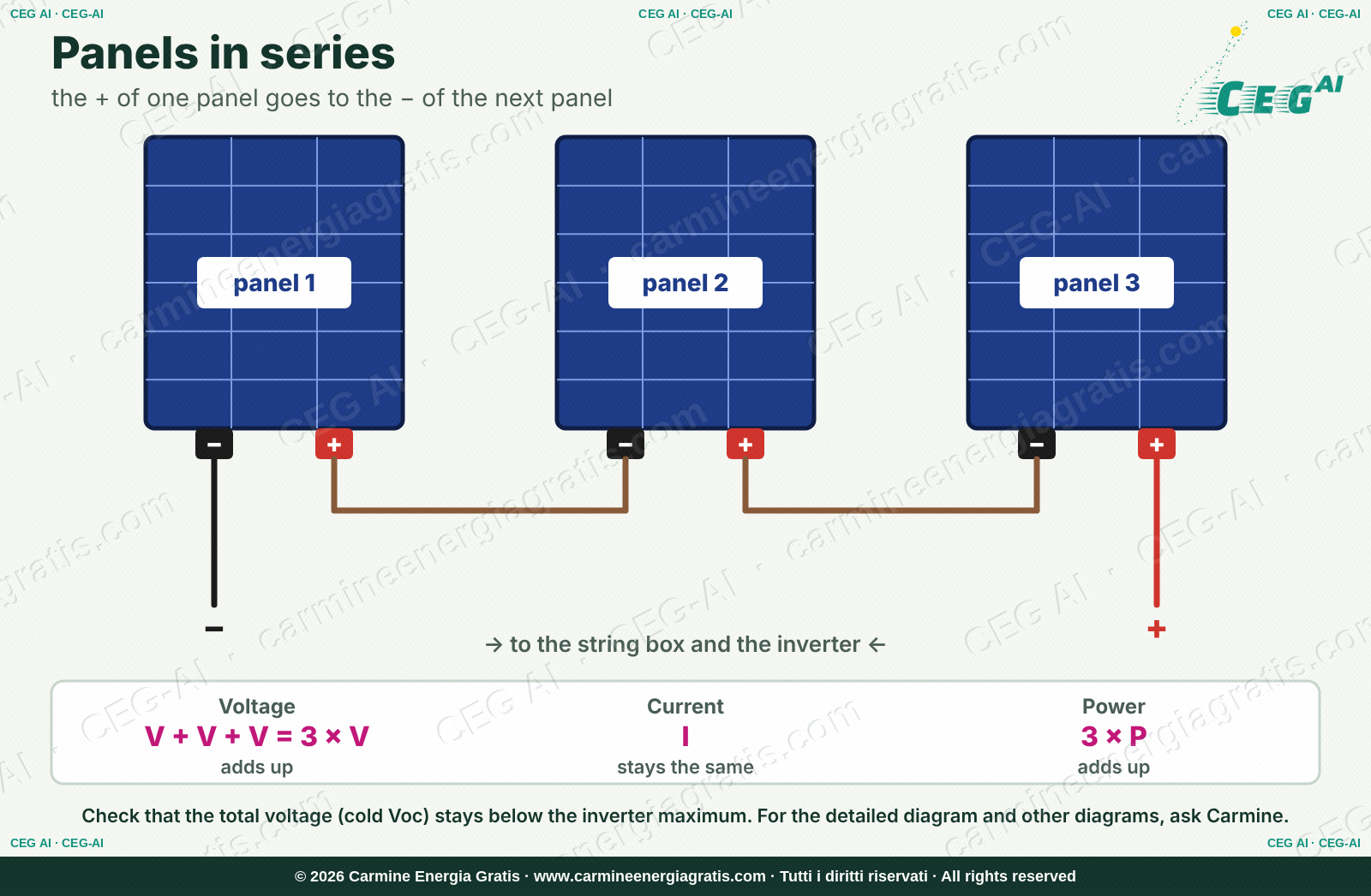
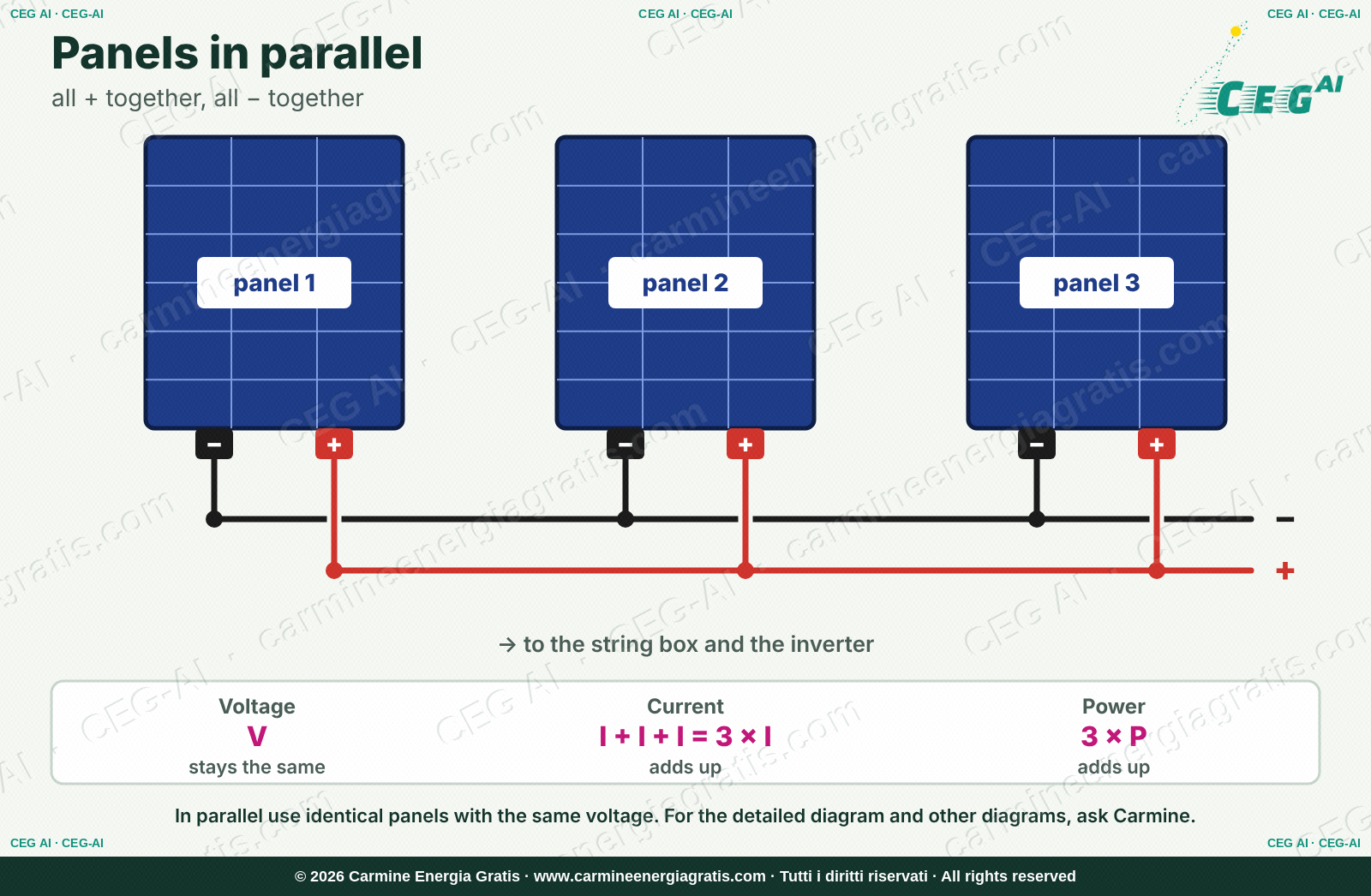
CEG videos and off-grid guide
- Off-grid solar system, complete series: 7 videos, from choosing the components to the finished system. Video
Learn more: Off-grid guide
Video: the TOP solar simulator in action
Carmine shows the simulator step by step (in Italian): roof, obstacles with their height, trees, month-by-month shading, strings and optimisers, up to the PDF project.

Frequently asked questions
Is the CEG solar simulator free?
Yes, it is free and needs no registration. You download and keep the PDF project.
Does it calculate the shade of chimneys and trees?
Yes. You draw chimneys, aerials, skylights, trees and nearby buildings with their height and the tool calculates the shade hour by hour every month, panel by panel.
Does it tell me if optimisers are needed?
Yes. For each panel it calculates the yearly and worst-month loss and recommends an optimiser only where shade falls in the productive hours.
What data do I need?
Your location, your consumption and, for the roof, width, depth, orientation and tilt. Panel power, Voc and Isc are optional.
Where does the solar data come from?
From the European JRC PVGIS service, with historical data for your location.
Can I build a DIY solar system? Is it legal?
You can design it yourself: with this simulator you size roof, panels, strings and battery, and the off-grid guide and the 7-video series explain the components up to the finished system. In Italy, installation on buildings covered by Ministerial Decree 37/2008 must be done by an authorised business, off-grid included: Carmine can suggest an installer in your area.
How much does a solar system with battery cost?
It depends on panel power, battery capacity and installation. As a reference, with CEG components a 6 kW Growatt inverter (€750, Europe) and a 16 kWh maximum battery (€1,630) cost €2,380 DDP; panels, mounting, cables, protection and installation come on top. The simulator tells you how many kWp and kWh you really need.
How many solar panels does my house need?
Enter your postcode and consumption: the simulator uses PVGIS solar data for your area, estimates production month by month and shows how many panels fit on the roof and how much energy they cover, even in the worst month.
How do I find a solar installer?
Download your project from the simulator and write to Carmine: he works with installers in several Italian cities and tells you whether a technician is available in your area.
Do I need a generator in winter with off-grid solar?
It depends on consumption, panels and battery. The simulator also checks the worst month and warns you if winter production is not enough and a generator is advisable; the generator and 1-0-2 switch diagram shows how to connect it.
More answers on the FAQ page, or write to Carmine.