


1. What it is for
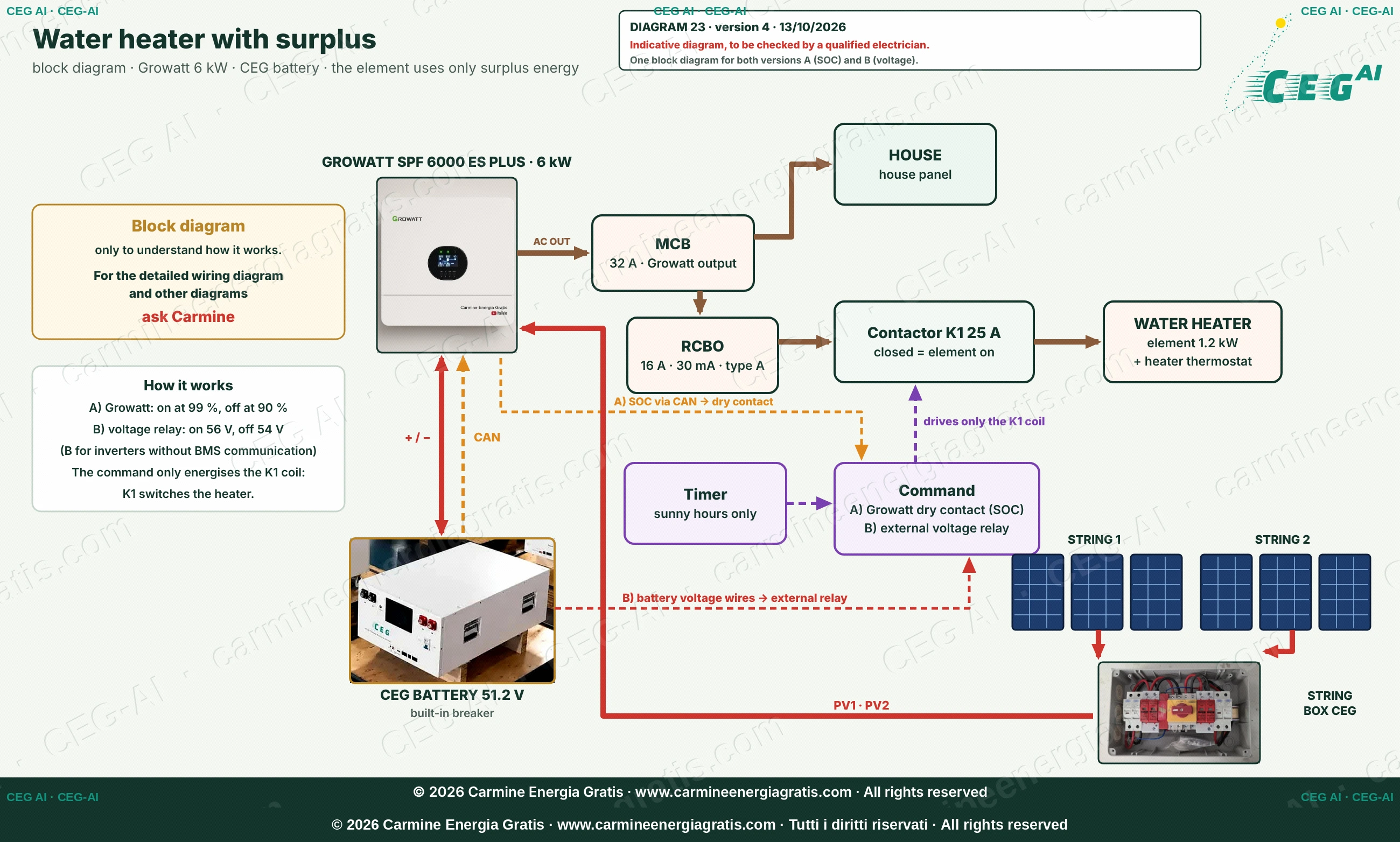
In an off-grid system, when the battery is full and the house uses little power, the Growatt reduces the panels' output: that energy is simply not used. With this diagram you use it to heat the water in the tank, which becomes a kind of «hot water battery».
The diagram is for off-grid systems, with or without the grid as backup.
2. What you need
- Growatt SPF 6000 ES PLUS inverter with CEG 51.2 V battery. Growatt inverters · Batteries
- Contactor K1 (25 A in the CEG diagram): it switches the water heater on and off.
- RCBO for the heater line (16 A, 30 mA, type A in the CEG diagram).
- Electric water heater with its thermostat. In the CEG example the element is 1.2 kW.
- The command: the Growatt dry contact or an external voltage relay (see below).
- A timer, so the heater can only start during sunny hours.
3. How it works
A small command tells the contactor when there is surplus energy, and the contactor switches the heater on. The command can be of two kinds.
Version A: Growatt dry contact (by state of charge)
If the battery communicates with the Growatt (CAN cable), the Growatt knows the state of charge (SOC). In the CEG diagram the dry contact closes at 99 % and opens again at 90 %: the heater only runs when the battery is practically full.
Version B: external voltage relay
If the inverter does not communicate with the battery BMS, it does not know the percentage: a relay measuring the battery voltage is used. In the CEG diagram it switches on at 56 V and off at 54 V.
In both versions the heater thermostat keeps doing its job: when the water is hot, the element stops by itself.
4. Why a contactor is needed
The Growatt dry contact (or the voltage relay) is made to command, not to power a load such as a heating element. That is why it only drives the coil of contactor K1: K1, sized for the heater current, closes the element circuit.
5. Mistakes to avoid
- Connecting the heater directly to the dry contact.
- An element too large for the available surplus: instead of using the surplus, it drains the battery.
- On and off thresholds too close: the contactor keeps switching on and off.
- Skipping the line protection (RCBO) or the earth connection.
6. The detailed wiring diagram
The block diagram helps you understand how it works. The detailed wiring diagram, with terminals and connections, is reserved for those who bought through Carmine Energia Gratis: write to Carmine with your CEG pre-order number. Wiring and testing must be done by a qualified electrician.
7. Frequently asked questions
Does it work if I keep the grid as backup?
Yes. The CEG diagram is designed for off-grid systems, with or without the grid as backup: the heater only uses surplus solar energy when the battery is full.
Can I use a more powerful element?
It depends on how much surplus your panels produce and on the inverter power. An element that is too large drains the battery instead of using the surplus: ask Carmine before choosing it.
What is the difference between version A and version B?
Version A uses the Growatt dry contact and the state of charge, and requires the battery to communicate with the inverter. Version B uses a relay measuring the battery voltage, for inverters that do not communicate with the BMS.
What happens at night?
At night there is no surplus: the battery drops below the off threshold and the timer limits operation to sunny hours, so the heater stays off.
Can I wire it myself?
The block diagram is for understanding how it works. Wiring and testing must be done by a qualified electrician.
Talk to Carmine
Before choosing components and connections, let us check your system together.