


1. How to wire them
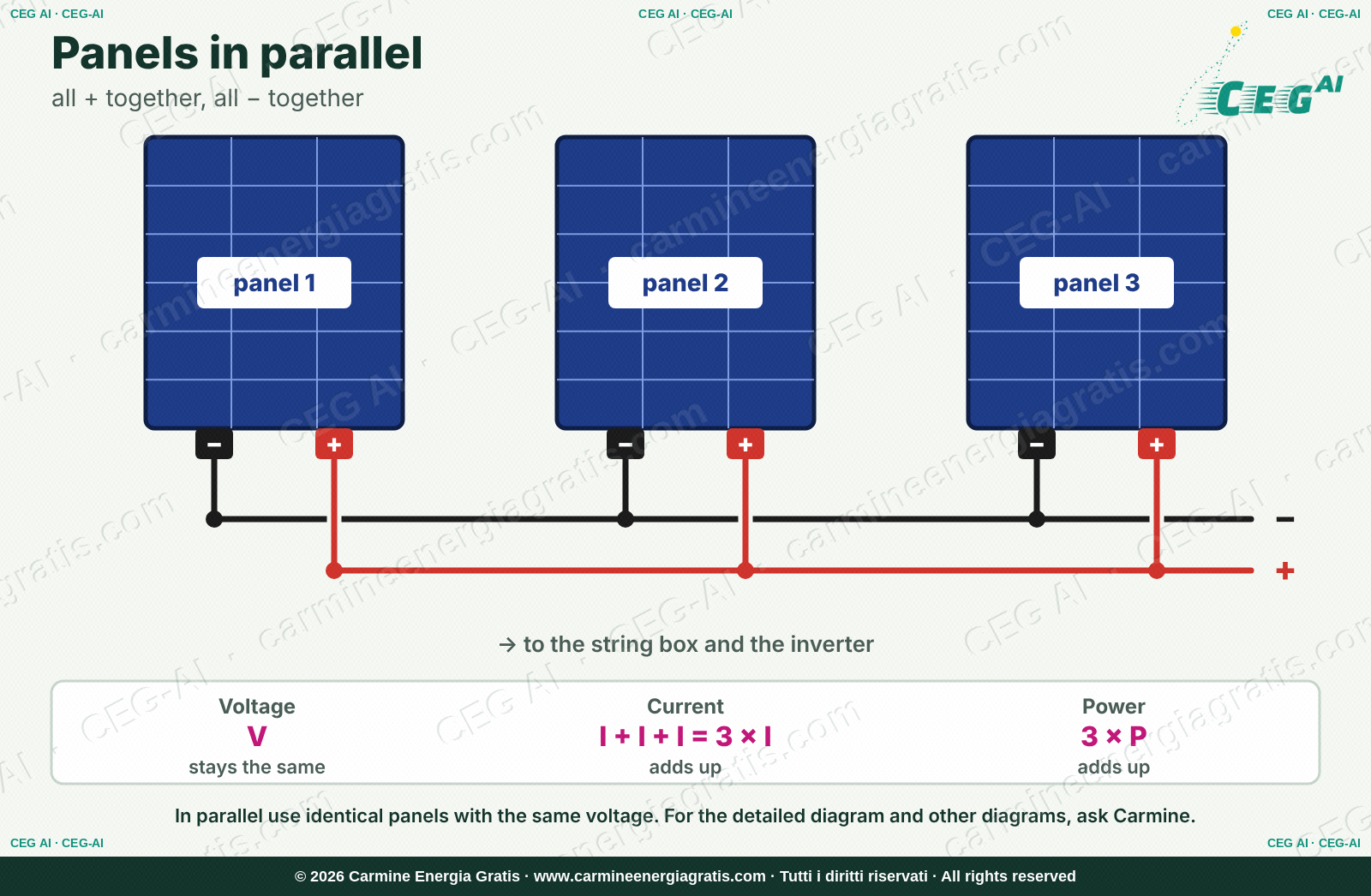
In parallel all the + go together and all the − go together. The same applies to several strings in parallel.
2. What happens
Current adds up, voltage stays the same. For example, two 40 V, 13 A panels in parallel give 40 V and about 26 A.
More current means thicker cables and more attention to the inverter input current limit.
3. The current limit
Each MPPT input has a maximum current: on the Growatt SPF 6000 ES PLUS it is 16 A per input. With parallel wiring this limit is reached quickly. A mix is often better: panels in series to build voltage, and at most one string per input.
4. String fuses
With several strings in parallel (as a rule from 3 upwards), if one fails the others can push their current into it. That is why string fuses (gPV) are needed, chosen on the panel short-circuit current and never above the maximum fuse rating on the label. The CEG string box has them anyway, 16 A. DC box
5. Mistakes to avoid
- Exceeding the MPPT input maximum current.
- Paralleling strings with different voltages.
- Three or more strings in parallel without fuses.
6. The detailed wiring diagram
The block diagram helps you understand how it works. The detailed wiring diagram, with terminals and connections, is reserved for those who bought through Carmine Energia Gratis: write to Carmine with your CEG pre-order number. Wiring and testing must be done by a qualified electrician.
7. Frequently asked questions
When does parallel make sense?
When putting all panels in series would exceed the inverter maximum voltage, or with low-voltage panels.
Are fuses always needed?
As a rule from 3 strings in parallel upwards. The CEG string box has them anyway, 16 A per string.
Can I parallel different panels?
Strings in parallel must have the same voltage, otherwise they work poorly. Identical panels are best.
Which cable do I need?
H1Z2Z2-K solar cable, sized for the total current and the length. The electrician chooses it.
Talk to Carmine
Before choosing components and connections, let us check your system together.